

AMD Detection
Answering Machine Detection (AMD) automatically determines whether a call was answered by a human or a voicemail system. This allows the platform to route human-answered calls to agents instantly while automatically leaving voicemail messages on machines — avoiding wasted agent time on voicemail greetings.
Two-Layer Detection
Section titled “Two-Layer Detection”Dialer.CX uses a two-layer approach for maximum accuracy, combining fast heuristic detection with AI-powered deep analysis.
Layer 1: Fast Detection
Section titled “Layer 1: Fast Detection”Rapid initial classification based on audio patterns:
- Analyzes greeting duration, silence gaps, and word patterns
- Results in under 1 second for minimal call connection delay
- High confidence results are acted on immediately
- Uncertain results are escalated to Layer 2
Layer 2: AI Classification
Section titled “Layer 2: AI Classification”AI-powered deep analysis for ambiguous cases:
- Uses your configured AI provider for advanced audio classification
- Analyzes speech cadence, vocabulary, and greeting structure
- Higher accuracy for edge cases like short human greetings or unusual voicemail messages
- Provider and confidence threshold configurable per campaign
Configuration
Section titled “Configuration”Navigate to Admin > AMD with four management tabs.
Dashboard Tab
Section titled “Dashboard Tab”Real-time AMD performance analytics:
- Campaign-level AMD accuracy statistics with human vs. machine breakdown
- Daily accuracy trends charted over time
- False positive and false negative rates per campaign
- Performance comparison across campaigns to identify tuning opportunities
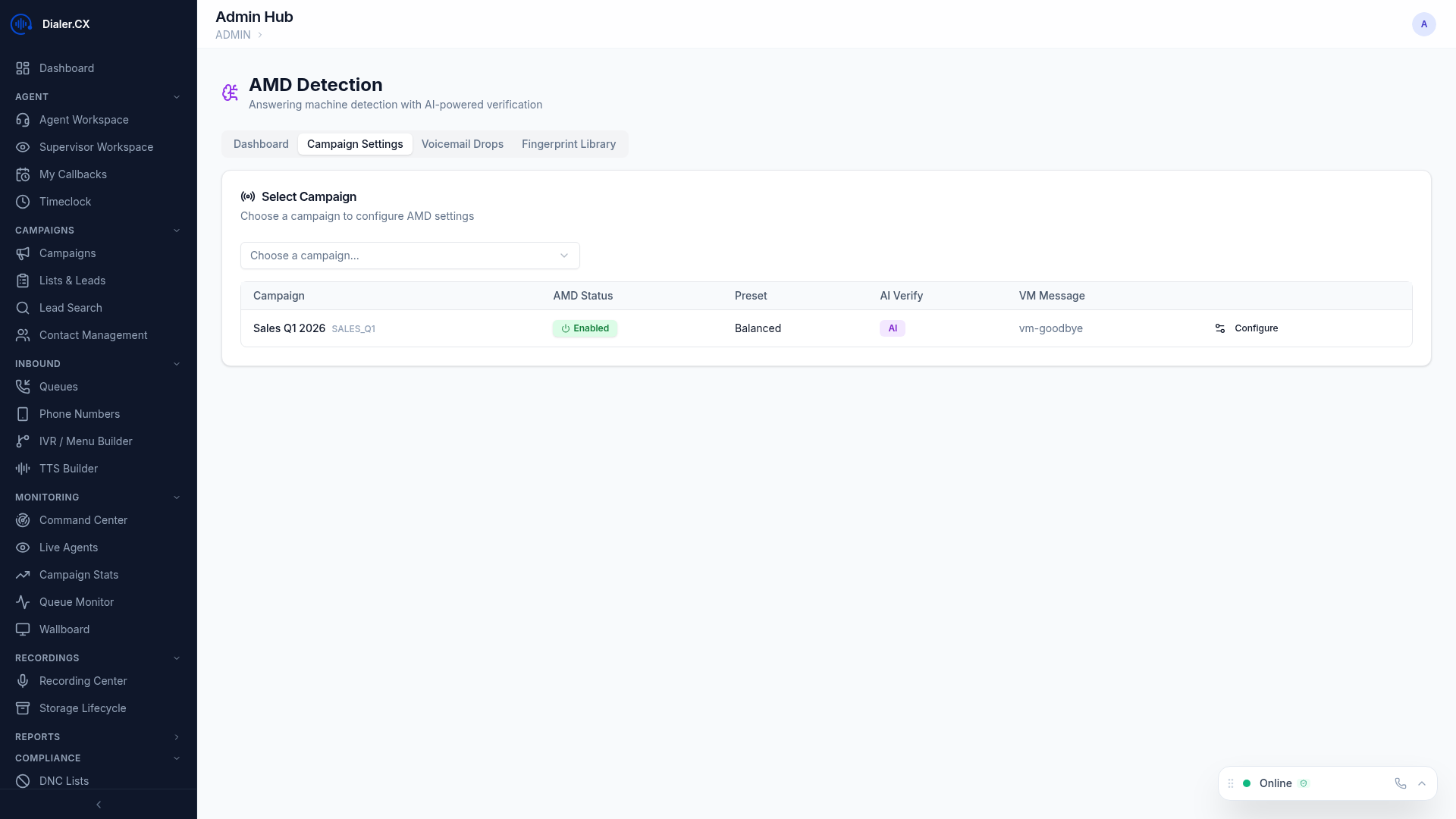
Campaigns Tab
Section titled “Campaigns Tab”Per-campaign AMD tuning parameters:
| Setting | Description |
|---|---|
| Enable AMD | Turn detection on/off per campaign |
| AI Classification | Enable Layer 2 AI analysis for uncertain cases |
| Confidence Threshold | Minimum confidence score for machine classification (lower = more aggressive) |
| Initial Silence | Maximum silence duration before greeting starts (ms) |
| Greeting Duration | Maximum greeting length before flagging as machine (ms) |
Voicemail Drop Tab
Section titled “Voicemail Drop Tab”Pre-recorded messages for automatic delivery to answering machines:
- Upload audio files directly or generate via TTS using the built-in text-to-speech engine
- Assign different voicemail messages per campaign for targeted messaging
- Automatic delivery when voicemail is detected — no agent involvement needed
- Track delivery success rates
Fingerprints Tab
Section titled “Fingerprints Tab”Known voicemail greeting pattern library:
- Carrier voicemail pattern database (e.g., “The person you are calling is not available…”)
- Improves Layer 1 detection accuracy by matching known patterns
- Auto-learning from confirmed classifications builds the library over time
- Reduces false positives by recognizing carrier-specific greeting formats
How AMD Integrates with Campaigns
Section titled “How AMD Integrates with Campaigns”The AMD flow for each outbound call:
- Call connects — audio stream begins
- Layer 1 analysis — fast heuristic classification runs immediately
- High confidence human — call routes to the next available agent
- High confidence machine — voicemail drop message plays (if configured)
- Uncertain — Layer 2 AI classification runs (if enabled)
- Layer 2 result — routes to agent or drops voicemail based on AI classification