

Caller ID Management
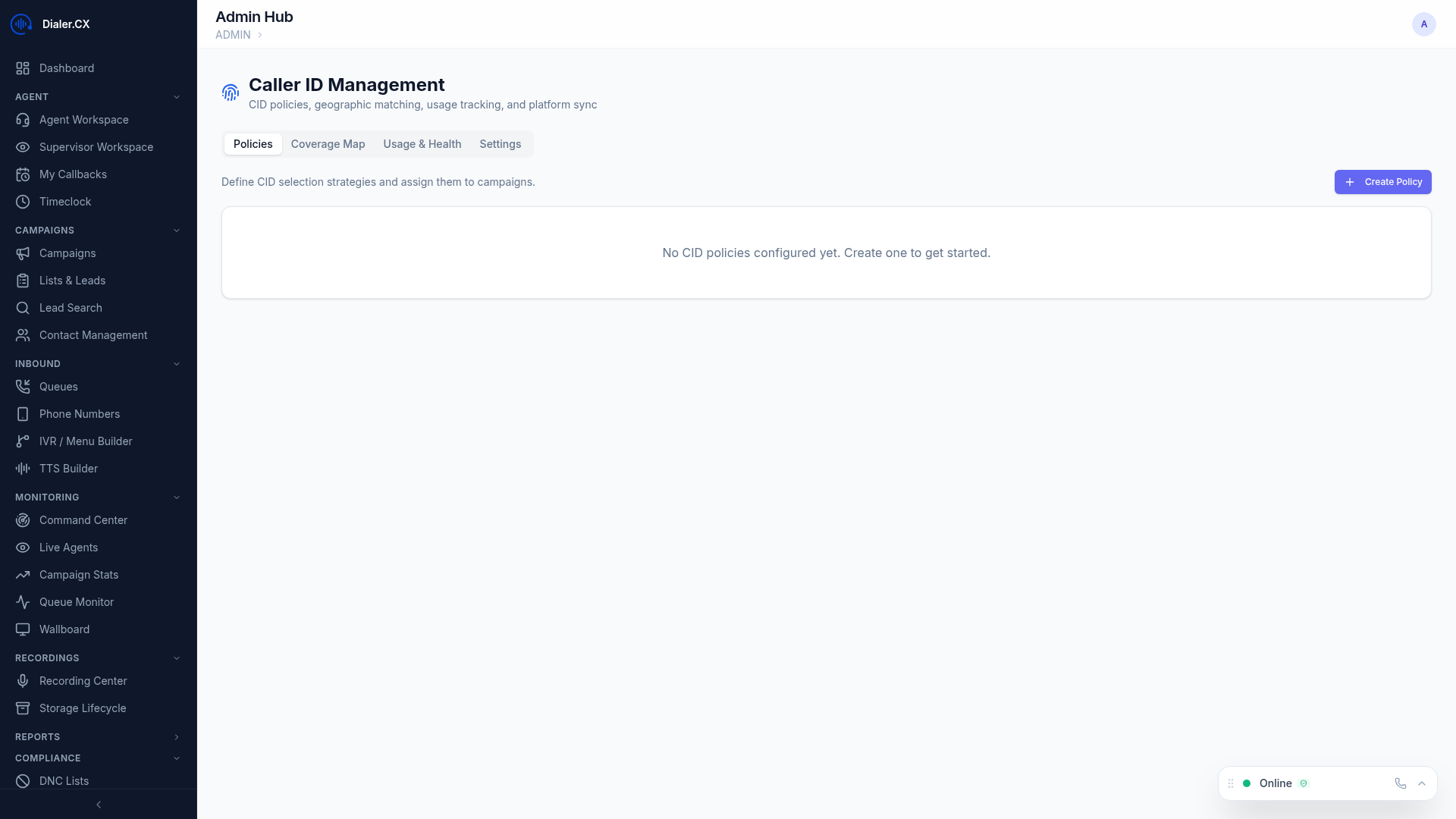
Dialer.CX provides advanced Caller ID management with six rotation strategies, usage tracking, and flag detection. Proper CID management directly impacts answer rates — local presence dialing and healthy number rotation can increase contact rates by 30% or more.
CID Numbers
Section titled “CID Numbers”Manage your inventory of caller ID numbers:
- Add numbers individually or in bulk
- Track per-number usage (daily call count)
- Flag detection — identify numbers that may be flagged as spam
- Active/inactive toggle
CID Groups
Section titled “CID Groups”Organize numbers into rotation groups:
- Group related numbers (e.g., all 212 area codes)
- Assign groups to rotation policies
- Multiple groups per policy for larger pools
Rotation Strategies
Section titled “Rotation Strategies”Six built-in strategies for selecting which caller ID to display:
| Strategy | How It Works | Best For |
|---|---|---|
| Round Robin | Cycles through CIDs sequentially | Even distribution |
| Random | Random selection per call | Simple rotation |
| Area Code Match | Matches CID area code to lead’s area code | Local presence dialing |
| State Match | Matches CID to lead’s state | Regional presence |
| Least Used | Uses the CID with fewest recent calls | Flag avoidance |
| Weighted | Proportional usage based on assigned weights | Custom distribution |
CID Policies
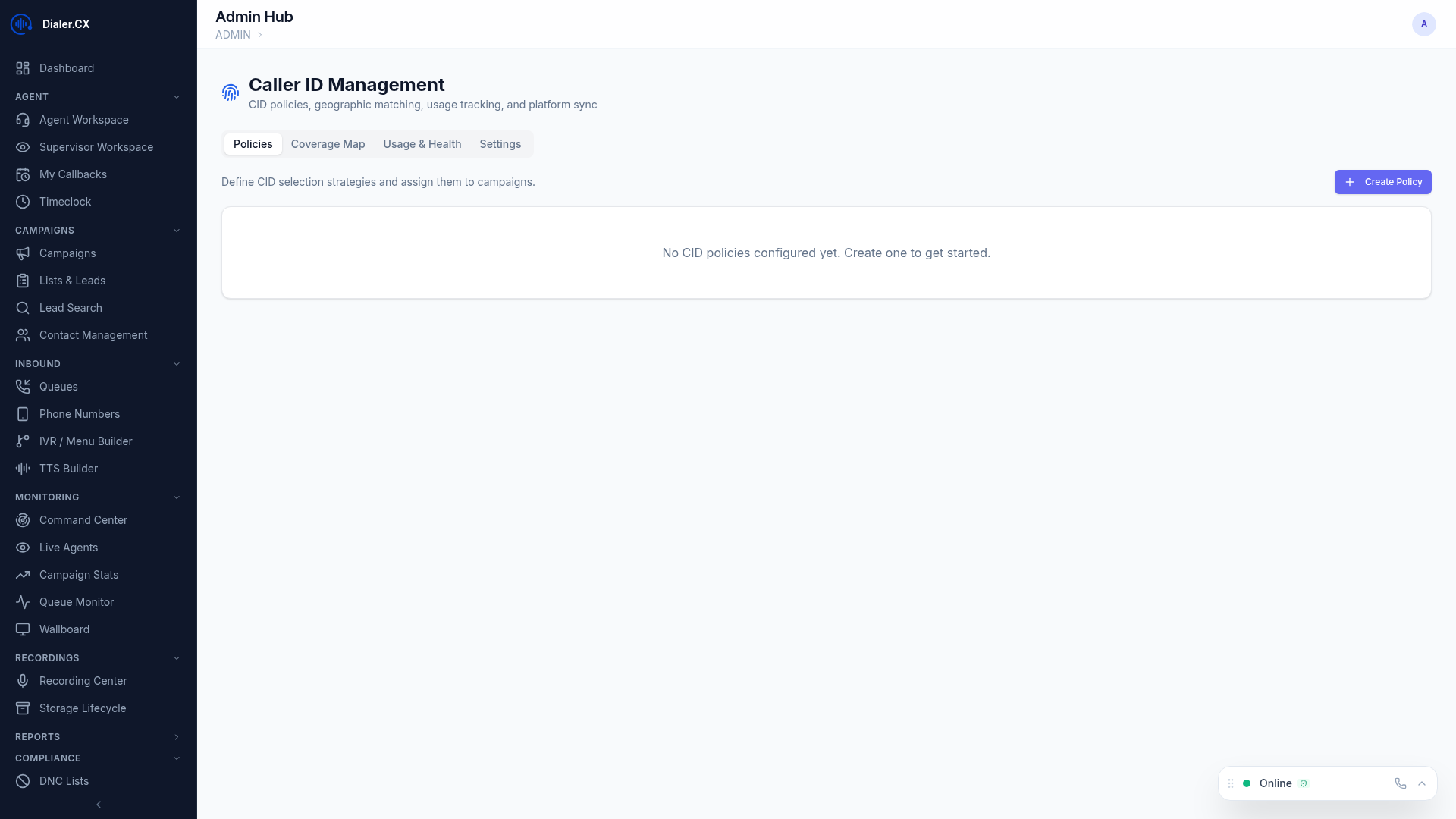
Section titled “CID Policies”Create policies that combine strategies with CID groups:
- Select a rotation strategy
- Assign one or more CID groups
- Assign the policy to campaigns
- The system automatically selects the best CID per call
Area Code Matching
Section titled “Area Code Matching”For local presence dialing:
- Built-in geographic database with 321 US area codes
- Automatic matching of lead area code to CID area code
- Fallback to a default CID when no match exists
- State-level matching as an alternative
Usage Tracking & Analytics
Section titled “Usage Tracking & Analytics”- Per-CID daily statistics — call count, answer rate
- Flag detection — identify numbers that may have been reported
- Health monitoring — track CID performance over time
- Usage caps — limit calls per number per day to reduce flagging risk